
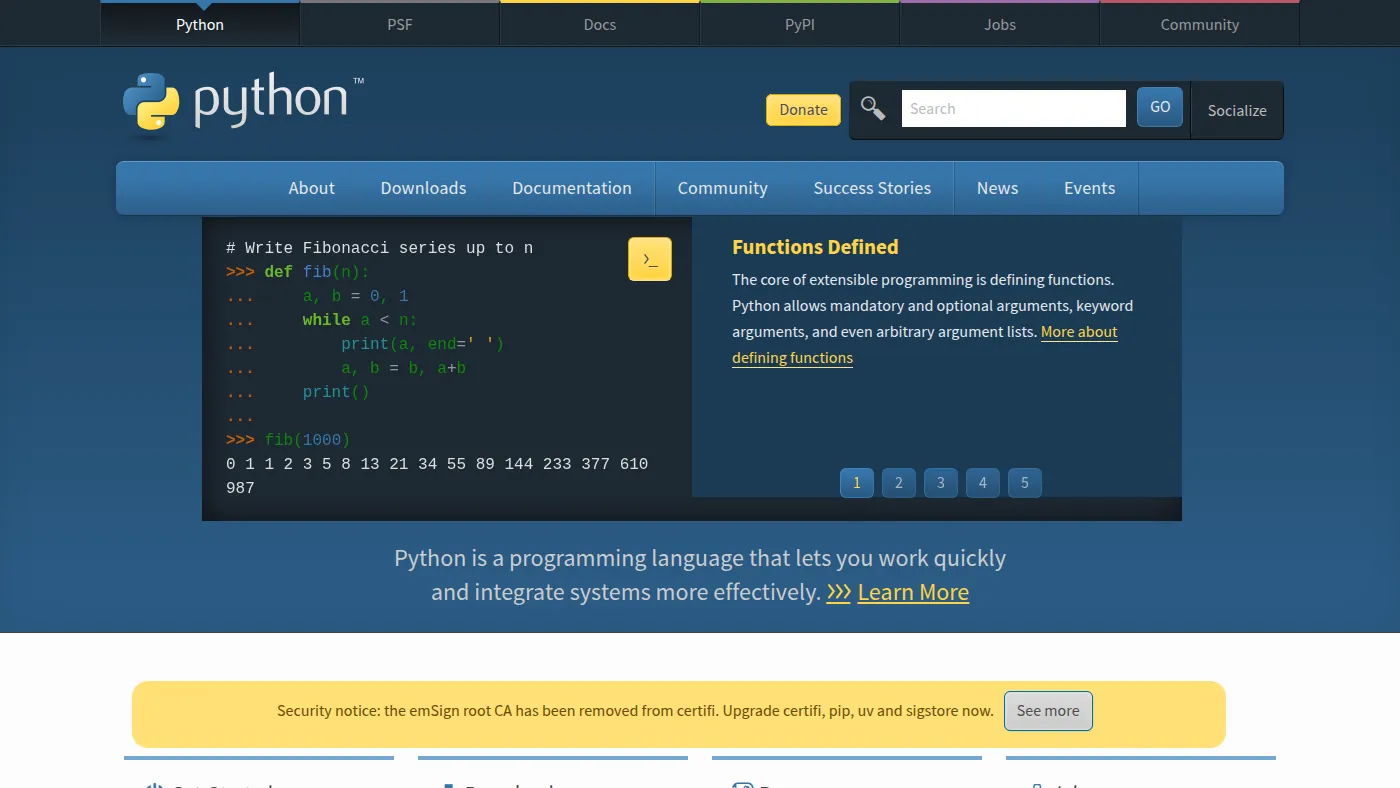
What is Python, in plain English?
Python is a programming language, a structured way of giving a computer instructions it can follow. It was created by Guido van Rossum and first released in 1991, and it is completely free and open source.
What makes the Python programming language different is how it reads. Its code looks close to plain English, so a beginner can often guess what a short program does just by reading it, no wall of symbols to decode first.
Think of a programming language as a recipe written for a very literal cook. The computer follows each step exactly as written, every time, without getting tired or skipping a line, Python is simply one of the clearest recipe styles ever invented.
Here is a tiny example: the line print("Hello, new customer!") simply tells the computer to show that message on screen. Short, readable instructions like that are why Python for beginners usually starts writing real programs on day one.
Why did Python become the world's most-used language?
Python currently ranks first on the TIOBE index, which tracks programming language popularity. In Stack Overflow's 2025 developer survey, 57.9% of respondents said they use Python in their work, more than any other language in that survey's professional rankings.
Three reasons explain the rise. Python is easy to start, it is free, and it comes with an enormous library of ready-made tools, so developers rarely have to build common things from scratch.
The community matters too. Millions of people use Python, which means tutorials, answers and examples exist for almost any problem a beginner or a business will ever run into.
The recent surge has a clear cause: artificial intelligence. Stack Overflow linked Python's jump in usage directly to AI, data science and backend work, and Python is the main language inside most AI projects being built today.
What is Python used for in a real business?
Automation: Python quietly handles repetitive computer work, renaming and sorting files, sending reminder emails, copying data between tools, and preparing weekly reports. These are small scripts, but they return hours every single week.
AI tools: most modern artificial intelligence is built with Python first. Chatbots, document readers that extract data from PDFs and invoices, and tools that draft and summarise text usually have Python working behind the scenes.
Website backends: the part of a website visitors never see, accounts, orders, payments, data, is often written in Python. Instagram, for example, runs on Django, a framework built with the Python programming language.
Data and reports: Python turns messy spreadsheets into clean summaries. Business owners use it to see which products actually make money, which customers are overdue, and where time is being lost.
Notice the pattern: none of these uses require a big software department. Most start as one small, focused script solving one annoying problem, and small, focused scripts are exactly what Python does best.
How Python compares with other languages
Python vs JavaScript: JavaScript runs inside every web browser and powers what visitors see and click. Python usually works behind the scenes on the server, handling data, automation and AI, many websites use both, each where it is strongest.
Python vs Java or C++: those languages can run faster and suit very large, performance-critical systems. They also take longer to write and longer to learn, so a working tool usually arrives much sooner in Python.
The honest trade-off: Python is not the fastest language, and it is rarely used to build phone apps directly. For automation, website backends and AI, though, speed of building usually matters far more than raw speed of running.
For a business owner, the practical question is rarely which language is 'best'. It is which one gets a reliable tool built quickly, at a cost that makes sense, and that is the contest Python keeps winning.
Is Python hard to learn?
Honestly, it is one of the easiest languages to start, that is the whole point of its design. Most beginners write useful little programs within their first week, and the basics of Python for beginners can be learned in a few weeks of steady practice.
Two practical notes if you ever try it yourself. Always start with Python 3, the current version, the older Python 2 stopped being maintained in 2020, and use the free official tutorial on python.org, which was written for complete beginners.
What Python means for your business
You do not need to become a programmer to benefit from Python. It simply helps to know what Python is when you spot the same data entry, the same report, or the same follow-up email eating your week, that repeated work is exactly what Python for beginners was designed to take over, one small script at a time.
That is the side of Python I work on every day: I build automations and AI tools for small businesses, and Python powers a good share of them. If you want to see what that looks like in practice, my guide to seven automation workflows that save hours every week is linked below, it is a practical place to start, no code required.
How does this apply to your business?
Share the workflow or idea you’re considering.
Discuss This Topic