What this calculator measures
Most lead problems are framed as a marketing problem: not enough leads. For many small businesses the quieter leak is speed. The leads already arrive; the first reply just lands after the customer has booked someone else. This cost of lost leads calculator prices that specific leak, and only that leak, in three steps.
How the math works
The whole calculation fits in four lines, and the calculator above runs exactly these lines on your inputs:
Customers at a fast reply = leads per month × conversion rate.
Customers won now = customers at a fast reply × the share kept at your current response time.
Customers lost per month = customers at a fast reply − customers won now.
Revenue lost = customers lost × average customer value, per month, and × 12 per year.
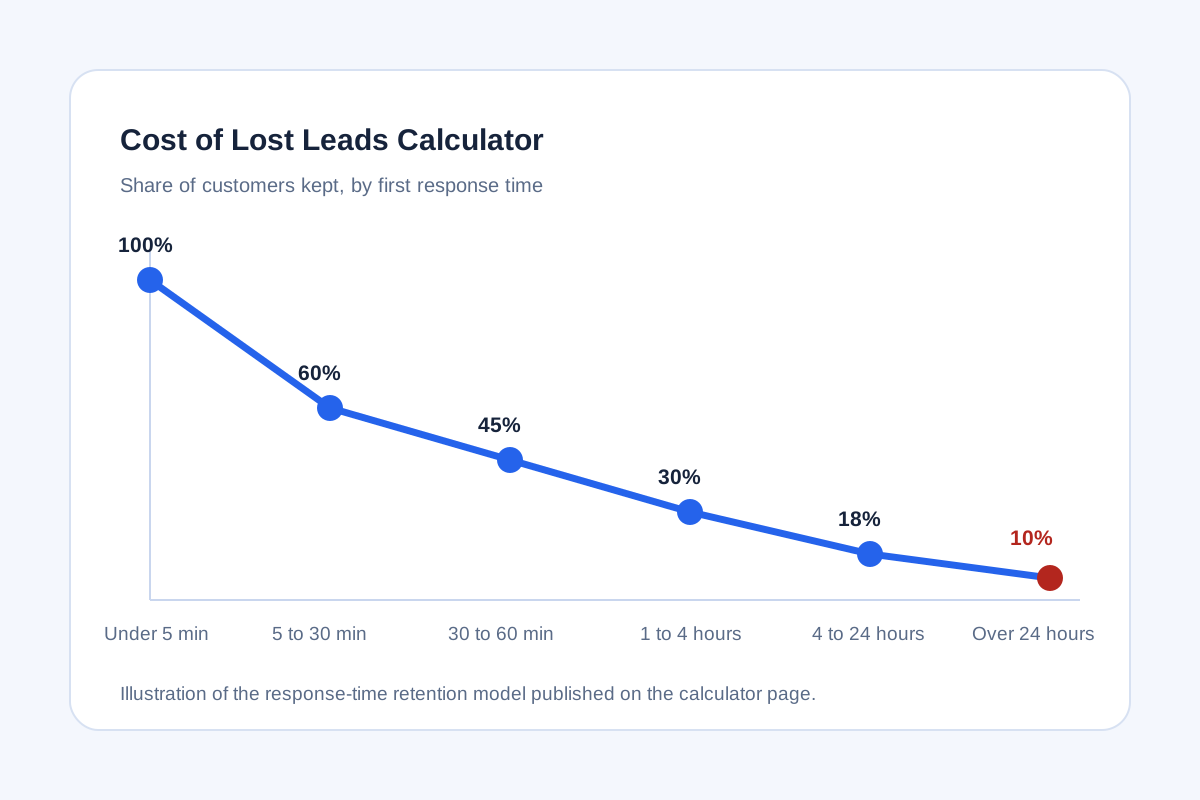
The share kept at each response speed is this calculator's conservative model, built from the published studies described in the benchmarks section below. The studies report odds ratios, not lost sales, so the model deliberately keeps more customers at each slow band than a raw odds conversion would. If anything, it understates the drop the research describes.
Sources: the Lead Response Management Study (Dr. James Oldroyd, InsideSales) and “The Short Life of Online Sales Leads”, Harvard Business Review, 2011. Both are summarized in the benchmarks section below, with their limits stated plainly.
One worked example, with every line shown
These are the calculator's own default example numbers, so you can type them in and check every line yourself. Illustrative inputs, not measured customer results.
Lead response time statistics: what the studies actually found
Two published sources sit under almost every lead response statistic on the internet, including this page. Here is what they actually say, and where their limits are.
The Lead Response Management Study (Dr. James Oldroyd, conducted at InsideSales, analyzing thousands of business-to-business leads) measured how qualification odds change with response speed. Its best-known finding: the odds of qualifying a lead were about 21 times higher when the first response came within 5 minutes than when it waited 30 minutes. The drop is steepest in the first half hour, which is why this calculator's model falls fastest in exactly that window.
The Harvard Business Review audit (“The Short Life of Online Sales Leads”, 2011) tested 2,241 US companies by submitting test leads and timing the response. Firms that responded within an hour were about 7 times more likely to qualify the lead than firms that took longer, and more than 60 times more likely than firms that waited 24 hours or more. The same audit is the source of the sobering benchmark for average lead response time: across those companies the average first response took 42 hours, and 23% never responded at all.
One more figure needs an honest label. You will often read that 78% of buyers purchase from the first business that responds. It is commonly cited across lead-management writing and is consistent with what both studies imply about first responders, but it does not trace to one published dataset you can inspect the way you can inspect the two studies above. Treat it as a warning about buyer behavior, not as a measured fact, and notice that this calculator's model does not use it anywhere.
The limit that matters most: both studies are about qualification odds on the leads they tracked, largely business-to-business. They are not a promise about your close rate. That is why the model on this page is a damped, conservative version of their findings, and why every result is labeled an estimate.
A lead response calculator for contractors and home services
Contractors and home service businesses feel slow response first, because the job is usually urgent and the customer is working down a list. A homeowner with a burst pipe or a dead air conditioner does not wait for your call back; they book the second company that answers. The Contractors and home services preset above starts from example numbers shaped like that trade: 80 leads a month, a $1,500 average job value and a 20% close rate. Replace them with your own; the shape of the result is what matters. At those example numbers, moving from a 1 to 4 hour first response to under 5 minutes is the difference between about 5 and about 16 customers a month in this model.
For contractors, the response-time problem and the missed-call problem are the same problem wearing two hats. Every missed call that never gets a call back is a lead whose first response time was effectively infinite. If your phone is your main lead source, this tool doubles as your missed call revenue calculator: choose Phone calls in the calculator, and the result prices your missed and slowly returned calls together. The fix is also shared: a missed-call alert with an automatic text back, and a same-day call-back list, so no ringing phone quietly becomes next month's lost revenue.
Why WhatsApp leads punish a slow first reply
WhatsApp is where this calculator's WhatsApp-first framing comes from, and it is the channel where lead follow-up delay cost is highest. A customer who messages a business on WhatsApp expects a conversation, at chat speed. The same person who would tolerate a day for an email reply reads a four-hour WhatsApp silence as a closed door, and messages the next business in the same ten minutes. For local services, clinics, salons, real estate agents and repair trades that take inquiries on WhatsApp, the first reply is effectively the storefront.
Two changes move a WhatsApp lead from the slow bands to the fast one. First, an instant auto-reply: a message that lands in seconds, confirms the inquiry, asks the one question that qualifies it (the service, the area, the timing) and sets an honest expectation for the human reply. Second, team alerts: the new lead pings whoever is on duty, with the lead's own words in the alert, so the human follow-up starts from context instead of from a cold inbox check hours later. Neither replaces the human conversation that wins the job; together they make sure it happens while the customer is still deciding.
Speed to lead, translated into revenue
Speed to lead is usually discussed as a stopwatch metric: minutes to first response. This page exists to translate it, because stopwatch numbers rarely change behavior and revenue numbers do. Used that way, the tool above is a speed to lead revenue calculator: it takes your current response band, applies the published model, and returns the lead follow-up delay cost in customers per month and dollars per year. That framing points at the right fix, too. The goal is not a heroic one-off fast reply; it is a system where the typical first response, including evenings and weekends, lands in the band your revenue can afford.
Frequently asked questions